
Engineering Mechanics and Strength of Materials – part 2
Examination Summary
0 of 20 Questions completed
Questions:
Information
You have already completed the examination before. Hence you can not start it again.
Examination is loading…
You must sign in or sign up to start the examination.
You must first complete the following:
Results
Results
0 of 20 Questions answered correctly
Your time:
Time has elapsed
You have reached 0 of 0 point(s), (0)
Earned Point(s): 0 of 0, (0)
0 Essay(s) Pending (Possible Point(s): 0)
Categories
- Not categorized 0%
-
Please get your copy here,
Engineering Mechanics and Strength of Materials
- 1
- 2
- 3
- 4
- 5
- 6
- 7
- 8
- 9
- 10
- 11
- 12
- 13
- 14
- 15
- 16
- 17
- 18
- 19
- 20
- Current
- Review / Skip
- Answered
- Correct
- Incorrect
-
Question 1 of 20
1. Question
Which of the following is NOT a type of support condition in engineering mechanics?
CorrectIncorrect -
Question 2 of 20
2. Question
Which of the following is a necessary condition for a body to be in equilibrium under the action of a system of forces?
CorrectIncorrect -
Question 3 of 20
3. Question
Which of the following is true about the centroid of an area?
CorrectIncorrect -
Question 4 of 20
4. Question
Which type of stress is induced in a material subjected to a twisting force or torque?
CorrectIncorrect -
Question 5 of 20
5. Question
What is the term used to describe the maximum stress a material can withstand before failure in a uniaxial tension test?
CorrectIncorrect -
Question 6 of 20
6. Question
Which of the following is a measure of a material’s ability to deform plastically before fracture?
CorrectIncorrect -
Question 7 of 20
7. Question
A semicircle of radius 3 inches is drawn on the base of an inverted right triangle with a height of 9 inches. Determine the coordinates of the centroid of the composite area formed. Assume that the leg of the right triangle corresponding with the height coincide with the y – axis.
CorrectIncorrect -
Question 8 of 20
8. Question
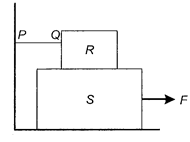
A block R of mass 100 kg is placed on a block S of mass 150 kg as shown in the figure. Block R is tied to the wall by a massless and inextensible string PQ. If the coefficient of static friction for all surfaces is 0.4, determine the minimum force F (in kN) needed to move the block S.
 CorrectIncorrect
 -
Question 9 of 20
9. Question
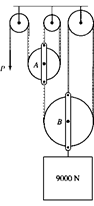
Determine the force P that will keep the pulley system in equilibrium. Neglect the weights of the pulley.
 CorrectIncorrect
 -
Question 10 of 20
10. Question
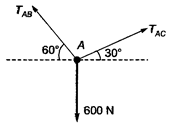
If point A is in equilibrium under the action of the applied forces, the values of tensions TAB and TAC are ______ and _______ respectively.
 CorrectIncorrect
 -
Question 11 of 20
11. Question
Assume that a 20-mm-diameter rivet joins two plates that are each 110 mm wide. The allowable stresses are 120 MPa for bearing in the plate material and 60 MPa for shearing of rivet. Determine the minimum thickness of each plate .
CorrectIncorrect -
Question 12 of 20
12. Question
A solid steel shaft 5 m long is stressed to 80 MPa when twisted through 4 degrees. Using G = 83 GPa, compute the shaft diameter.
CorrectIncorrect -
Question 13 of 20
13. Question
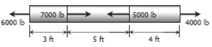
An aluminum bar having a cross-sectional area of 0.5 in2 carries the axial loads applied at the positions shown in the figure. Compute the total change in length of the bar if E = 10 × 106 psi. Assume the bar is suitably braced to prevent lateral buckling.
 CorrectIncorrect
 -
Question 14 of 20
14. Question
Two bodies of the same mass are moving with the same speed, but in different directions in a plane. They have a completely inelastic collision and move together thereafter with a final speed which is half of their initial speed. The angle between the initial velocities of the two bodies (in degree) is
CorrectIncorrect -
Question 15 of 20
15. Question
A person pushes a box on a rough horizontal platform surface. He applies a force of 200 N over 15 m. Thereafter, he gets progressively tired, and his applied force reduces linearly with distance to 100 N. The total distance through which the box has been moved is 30 m. What is the work done by the person during the total movement of the box?
CorrectIncorrect -
Question 16 of 20
16. Question
A 100 kg body moves to the right at 5 m/s and another body of mass W moves to the left at 3 m/s. They meet each other and after impact the 100 kg body rebounded to the left at 2 m/s. Determine the mass of the other body if coefficient of restitution is 0.5?
CorrectIncorrect -
Question 17 of 20
17. Question
A 40 g bullet with a speed of 300 m/s is fired into a ballistic pendulum of mass 5 kg suspended from a chord 1 m long. Compute the vertical height through which the pendulum rises.
CorrectIncorrect -
Question 18 of 20
18. Question
A steel shaft 3 ft long that has a diameter of 4 in. is subjected to a torque of 15 kip-ft. Determine the maximum shearing stress and the angle of twist. Use G = 12 × 106 psi.
CorrectIncorrect -
Question 19 of 20
19. Question
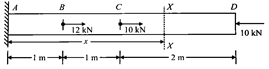
A steel rod, having a diameter of 40 mm is loaded as shown in the figure. Taking E = 200 GPa, determine the distance x from the left-hand support to a point at which the deformation is zero.
 CorrectIncorrect
 -
Question 20 of 20
20. Question
Determine the outside diameter of a hollow steel tube that will carry a tensile load of 600 kN at a stress of 150 MPa. Assume a wall thickness to be one – tenth of the outside diameter.
CorrectIncorrect